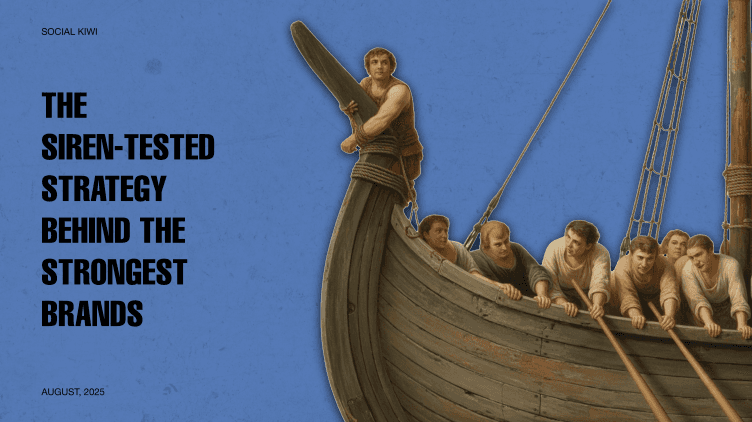
Ulysses knew the sirens’ song would wreck any ship. His crew plugged their ears.
Not him, he had himself tied to the mast and asked his pleas to be ignored.
Safety was just the surface. Control was the point. He built a constraint to save himself from his own worst decision.
The smartest brands do the same, setting limits now to protect themselves later. They're creating what behavioral economists call "Ulysses pacts."
Deliberate, often irreversible constraints that stop brands from making decisions that feel amazing in the moment but destroy them in the long run.
THE MOST EXPENSIVE DECISION NETFLIX NEVER MADE
Back in 2007, Netflix was killing it with DVDs-by-mail. Customers loved it. Revenue was climbing. Reed Hastings had a choice: keep milking the cash cow or gamble everything on this weird, still-tiny idea called streaming.
Most companies would play it safe, i.e., keep the old thing running, test the new thing quietly on the side.
Netflix? Nope. They went full Ulysses pact. Publicly declared they were all in on streaming. Started dismantling their own DVD business, and poured billions into content even before they had the subscribers to pay for it.
That one move made retreat impossible. Financially. Reputationally. They couldn’t be “just a DVD company” again, even if they wanted to.
Wall Street freaked out. The stock tanked. But here’s the thing: when there’s no way back, you have to figure it out. And because they had to, Netflix outpaced everyone.
Today, Blockbuster’s a punchline, and Netflix? Sitting pretty at over $150 billion.
THE BRAND THAT DELETED ITS OWN PLAYBOOK
Reformation built a $200M+ business by doing something that, on paper, sounds insane.
They’ve made their sustainability rules so strict that they literally can’t make most of the clothes their customers ask for.
No synthetics. No overproduction. No “it” pieces that won’t last. They even put the environmental cost of each item.
This means manufacturing is slower. It’s more expensive. It’s limiting.
And sure, the leadership could flip the switch tomorrow, churn out fast fashion, pump margins, and grow quicker. But they won’t. They can’t? The second they do, their entire brand promise crumbles.
Meanwhile, the rest of the fashion world is in a race to the bottom on price and speed. Reformation? They’ve got customers happily paying more, waiting longer, and coming back again and again. Sales have doubled to $300M, with double-digit profits.
On the surface, they sell clothes. Underneath, they sell certainty, the kind that comes from a brand built to never break its own rules.
WHY MOST BRANDS UNTIE THEMSELVES (AND LOSE)
For every Netflix or Reformation, there are dozens of brands that start strong but can’t commit to their own rules.
Take WeWork. Adam Neumann’s original idea was clear: build a global entrepreneur community. Then the definition kept expanding: co-living, wellness, education, until it was everything for everyone, and nothing stood out.
When you refuse to set limits, you get boxed in by everything else: the market, competitors, fickle customers, and investors chasing quick wins.
And there comes a moment when the sirens sing, a bad quarter, a competitor’s flashy success, investor pressure. That’s when your future self will want to loosen the ropes. The very constraints that made you special will feel like obstacles to ditch, not advantages to protect.
Brands with Ulysses pacts don’t get that choice. They’ve built their discipline into the structure, so breaking it isn’t even on the table.
THE COUNTER-INTUITIVE TRUTH
The smartest brands don’t keep every option open; they close most of them on purpose.
Because unlimited choices? They kill focus. And perfect flexibility? Nothing ever gets perfected.
The winners are the ones who tied themselves to the mast early, heard the sirens, and sailed past.
Everyone else is still arguing over which way to point the boat.
_What constraints has your brand been avoiding? The ones that make you uncomfortable might be exactly what you need to tie yourself to. _
_Let us know in the comments 🥝 _
Like what you see?